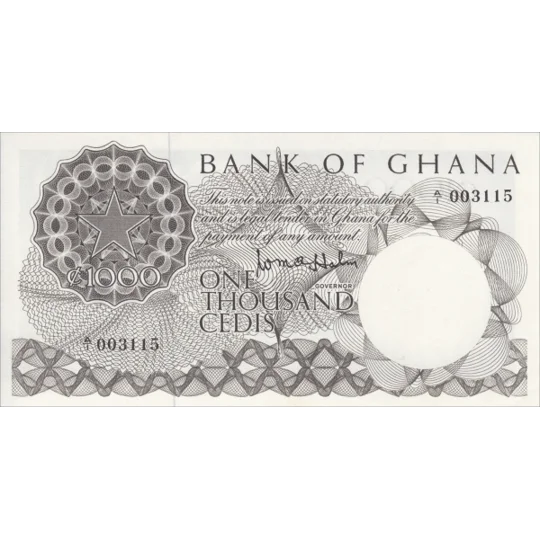
Discover the fascinating history behind the 1000 Cedis banknote from 1965, a true gem for collectors! This P9A note, graded Unc, showcases the vibrant spirit of Ghana as it transitioned to its own currency. Featuring a striking black design, the front displays English text alongside a star, while the back highlights the iconic Bank of Ghana building in Accra. With a solid security thread and a watermark of the esteemed Kwame Nkrumah, this note is not just a piece of currency but a symbol of Ghana's independence. With a rarity index of 97, this very rare banknote is a must-have for any serious collector. Don't miss your chance to own a piece of history with the 1000 Cedis - 1965 - P9A - B110!
SCWPM.#9A - TBB.#B110a - Very Rare banknote!
Date: ND (1965) - Grade: Unc - Original scan. - Signature: 3 - Prefix and serial: A/1- 003115
Description: Colour: Black. - Front: English text; star. - Back: Bank of Ghana building in Accra. - Solid security thread. - Watermark: Kwame Nkrumah. - Printer: ? - Size: 160 x 82 mm. - Material: Paper.
Numista rarity index 97 - 100 is very rare, number 0 is common. This is therefore an extremely rare note and UNC as well!
Numista zeldzaamheidsindex 97 - Ter info: 100 is zeer zeldzaam, cijfer 0 is algemeen biljet. Dit is dus een uiterst zeldzaam biljet en nog UNC ook!
Índice de rareza Numista 97. Para su información: el 100 es muy raro, el número 0 es común. Por lo tanto, este billete es extremadamente raro y, además, sin circular.
The Birth of the Cedi
The second issue of currency was in early 1965, when Ghana decided to leave the British colonial monetary system and adopt the widely accepted decimal system. Accordingly, Cedi notes and Pesewa coins were introduced on the 19th July, 1965 to replace the Ghana pounds, shillings and pence.
The cedi was equivalent to eight shillings and four pence (8s 4d) and bore the portrait of the then President, Dr. Kwame Nkrumah. The name “cedi” was derived from the word “sedie” meaning cowrie, a shell money which gained popularity and wider circulation in the later part of the 19th Century.
The “Pesewa” represented the smallest denomination (quantity) of the gold-dust currency regime.
The name was chosen to replace the British Colonial penny.
| Title | 1000 Cedis - 1965 - P9A - B110 - Unc |
|---|---|
| Brand | GHANA |
| Category | Ghana |
| SKU | GHC.110a |
| Condition | new |
| MPN | GHC.110a |