

Product Description
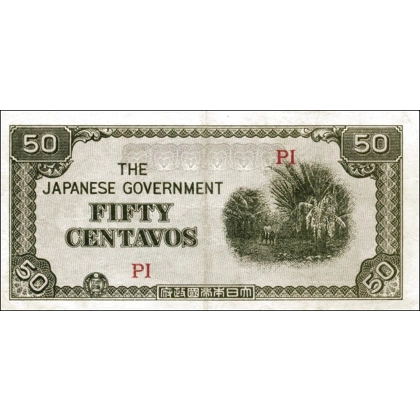
B804a - P105a - 50 centavos - ND (1942) - Grade: XF+ - No signature - Description: Colour: Black, blue, and violet. Front: English and Japanese text; coat of arms; two natives riding water buffalo amid banana trees. Back: Guilloche patterns. No security thread. Watermark: Quatrefoil pattern. Printer: 府政國帝本日大 (Greater Japan Imperial Government). Size: 120 x 58 mm. - Material: Paper - 2-letter series PI
Japanese Government
During World War II, the Empire of Japan invaded the Philippines on 8 December 1941. On 8 May 1942, Japanese troops took control of the country. On 14 October 1943, Japan declared the Philippines independent and established a puppet government with José Paciano Laurel as president.
1942 Occupation Issues
These notes, officially “Foreign Denomination Military Certificates,” were issued first by the Yokohama Specie Bank in 1942, and later by the Southern Development Bank. These notes bear the imprint of the Greater Japan Imperial Government in Japanese text at lower center front. All of these notes have series letters starting with the letter P. These notes are often collectively referred to as “JIM” for Japanese Invasion Money. Differences in paper color have been observed, but are subtle and inconsistent so they are not treated as separate varieties. These notes were lithographed front and back.
When the Philippines were liberated from Japanese occupation by US forces in 1945, many people held huge quantities of debased JIM. In the hope of having their notes redeemed, the Japanese War Notes Claimants Association of the Philippines (JAPWANCAP) was formed. JIM holders would give their notes to JAPWANCAP, who gave the holders receipts against future redemption and stamped the notes with a JAPWANCAP stamp.
In the end, no redemption for JIM was ever forthcoming, despite JAPWANCAP suing the US government for undermining the local currency by circulating counterfeits. The case went all the way to the US Supreme Court but was dismissed under the statute of limitations.